Trail Talk
Understanding Trail and Fork Offset
TECH TALK
1/9/20263 min read
Understanding Trail and Fork Offset in Mountain Biking
When mountain bikers talk about geometry, terms like head angle, reach, and wheelbase come up constantly. But one of the most important and often misunderstood concepts is trail.
Trail is heavily influenced by fork offset, and together they play a major role in how your bike handles on climbs, descents, tight corners, and high-speed terrain.
Let’s break it down from a practical mountain biking perspective.
What Is Trail?
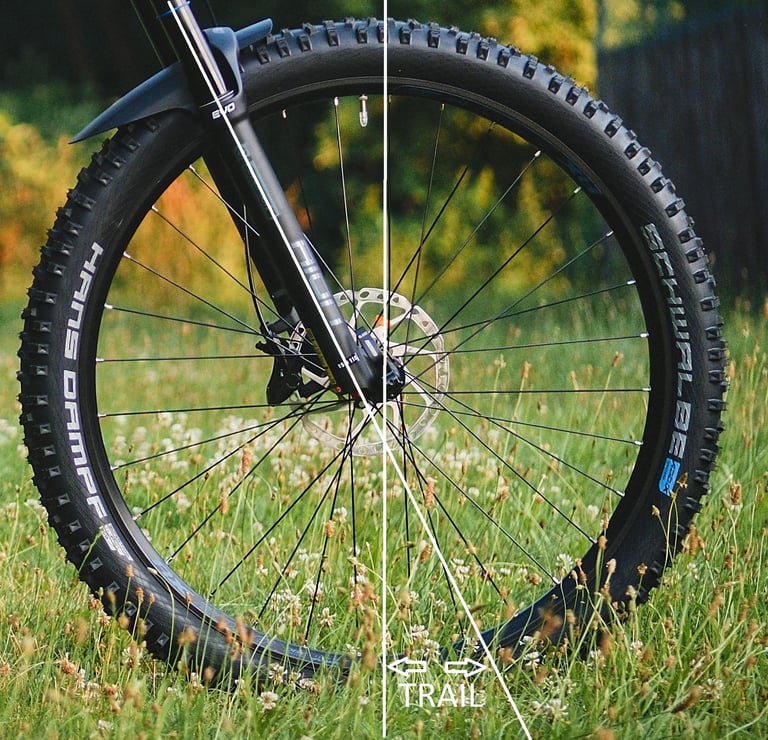
In simple terms, trail is the distance on the ground between:
Where your steering axis (an imaginary line running through your head tube) intersects the ground, and
Where your front tire actually contacts the ground.
That distance is called mechanical trail.
Trail is what gives a bike its natural tendency to self-center the same principle that makes a shopping cart wheel snap back into line behind its pivot. On a mountain bike, that self-centering effect provides stability.
More Trail =
Greater stability at speed
Stronger self-centering feel
More confidence on steep descents
Slower, more deliberate steering
Less Trail =
Quicker steering response
Lighter front-end feel
Easier low-speed maneuvering
Potentially twitchier handling at high speed
What Is Fork Offset?
Fork offset (sometimes called rake) is the horizontal distance by which the front axle sits forward of the steering axis.
If you look at a suspension fork from the side, you’ll notice the lowers bend slightly forward. That forward bend is the offset.
Common modern mountain bike fork offsets:
44mm (standard on many 29ers today)
51mm (older or more XC-focused 29er setups)
37mm (common on some 27.5” forks)
How Fork Offset Affects Trail
Here’s the key relationship:
Increasing fork offset decreases trail
Decreasing fork offset increases trail
Why?
Because moving the axle forward (more offset) reduces the horizontal distance between the steering axis contact point and the tire contact patch which reduces trail.
Why This Matters for Mountain Biking
Stability on Descents
Modern trail and enduro bikes often use:
Slacker head angles
Shorter fork offsets
Slacker head angles naturally increase trail. To avoid excessive steering sluggishness, manufacturers may reduce offset slightly to balance handling.
Lower offset forks (like 44mm on a 29er instead of 51mm) increase trail and give:
More planted front-end feel
Improved confidence on steep terrain
Better tracking through rough sections
This is why many aggressive bikes shifted from 51mm to 44mm offsets.
Cornering Feel
More trail (shorter offset):
Makes the front wheel want to stay straight
Requires slightly more input to initiate a turn
Feels stable mid-corner
Less trail (longer offset):
Initiates turns more quickly
Feels more agile at lower speeds
Can feel nervous on steep or rough terrain
On tight, slow-speed switchbacks, lower trail may feel more responsive. On fast, blown-out berms or technical descents, higher trail often feels more composed.
Front Wheel Traction
Higher trail setups (shorter offset forks):
Keep the front wheel tracking straighter
Increase front-end confidence in loose terrain
Improve composure when braking hard into steep sections
The front tire tends to “hold a line” better in rough conditions.
Climbing Behavior
At slower climbing speeds:
Lower trail (longer offset) can feel lighter and easier to steer
Higher trail setups can feel slightly heavier at the bars
However, modern geometry has largely minimized dramatic climbing differences.
Is There a “Best” Offset?
There’s no universally best choice — it depends on:
Wheel size (29” vs 27.5”)
Head angle
Intended riding style
Rider preference
For example:
29ers naturally have more trail due to larger wheel radius.
Shorter offsets (44mm) became popular to increase front-end composure without making steering floppy.
Manufacturers carefully tune offset alongside head angle and wheel size to achieve a specific ride character.
The Big Picture: It’s About Balance
Trail is not an isolated number. It works together with:
Head tube angle
Wheel size
Tire width
Front center length
Rider position
Fork offset is simply one tuning tool designers use to fine-tune trail.
Modern mountain bike geometry trends (slacker, longer bikes) made trail more important than ever. Shorter offset forks became popular because they complement slack head angles by keeping steering predictable and stable at speed.
Final Thoughts
From a mountain biking perspective:
More trail (shorter offset) = stable, planted, confident at speed
Less trail (longer offset) = quick, agile, responsive
If you ride aggressive trails, steep descents, or enduro terrain, you’ll likely appreciate the stability of a shorter offset fork.
If you prioritize tight, technical XC riding or slower-speed maneuverability, a longer offset may feel more responsive.
Ultimately, trail is what gives your front wheel its personality — and fork offset is one of the key tools shaping that personality.