
The Circular Trail
The Circular Trail
Closed-Loop Manufacturing and the Future of the Mountain Bike Industry
For decades the mountain bike industry has sold itself on freedom, nature, and adventure. Riders escape into forests, mountains, and wild places yet the bikes themselves are often built through one of the least environmentally friendly manufacturing systems imaginable.
Frames are shipped across continents. Carbon fibre waste goes into landfill. Perfectly repairable bikes are replaced every few years because of trends, standards changes, or cosmetic updates. Even worse, many of the materials used in modern bikes are incredibly difficult to recycle once they reach the end of their lives.
The industry has largely operated on a linear manufacturing model:
Extract → Manufacture → Sell → Dispose
Closed-loop manufacturing aims to change that completely.
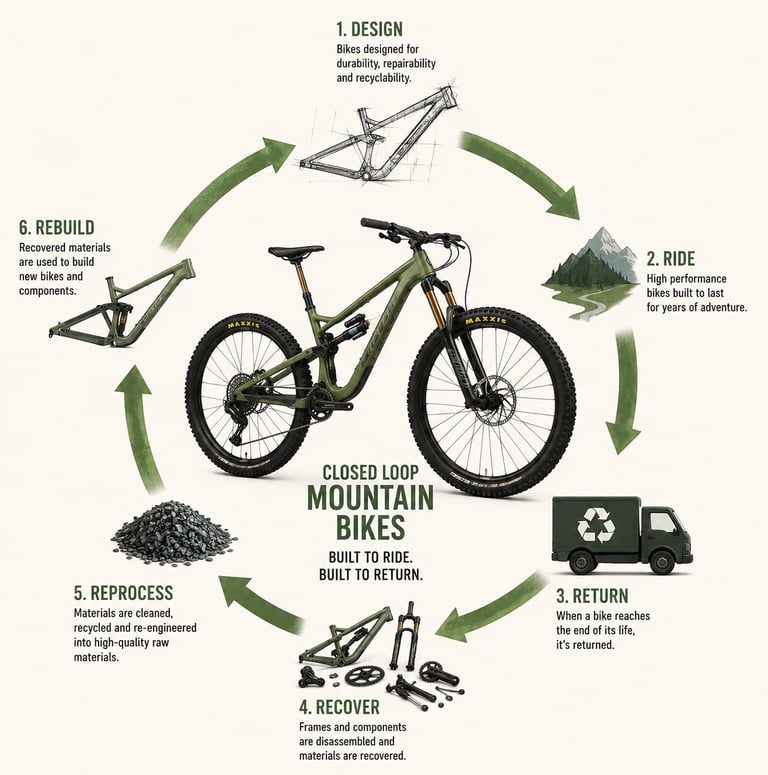
Instead of waste being the end of the story, the goal is to keep materials circulating continuously through the system:
Design → Use → Recover → Rebuild → Reuse
In simple terms, yesterday’s broken frame becomes tomorrow’s new bike.
And while that might sound futuristic, parts of the mountain bike industry are already trying to make it happen.
What Is Closed-Loop Manufacturing?
Closed-loop manufacturing is a form of circular economy production where materials are recovered after use and fed back into the manufacturing process instead of being thrown away.
In mountain biking, that could mean:
Recycling carbon fibre frame offcuts into new components
Melting down aluminium frames into new tubes
Reusing production waste inside new frames
Designing bikes that can be repaired rather than discarded
Creating frames from recyclable thermoplastics instead of permanent epoxy resins
Recovering worn-out bikes directly from customers
The important distinction is this:
Traditional recycling often “downcycles” materials into lower-grade products but closed-loop systems aim to keep materials valuable enough to become bikes again.
That is much harder.
Then there is the Carbon Fibre Problem.
Most people don't realise this but the biggest recycling problem in the cycling industry is carbon fibre.
Modern mountain bikes rely heavily on carbon because it is light, stiff, and easy to shape into complex designs. But most carbon frames use thermoset epoxy resins, which permanently cure during manufacturing.
Once cured, they cannot simply be melted down and reused and that means most carbon frames eventually become landfill waste.
Even the manufacturing process itself creates huge amounts of scrap material from cutting and trimming carbon sheets and for years the industry quietly ignored this problem because performance mattered more than sustainability.
There is some evidence that it is starting to change.
Rein4ced and the First Real Closed-Loop Bike Frames
One of the most ambitious attempts at true circular manufacturing came from Belgian composites company REIN4CED.
Rather than using traditional thermoset carbon fibre, they developed thermoplastic composite frames designed to be reheated, reshaped, and recycled. Their process reused manufacturing waste directly back into new frame production through a closed-loop recycling system.
Unlike conventional carbon frames, these materials offered:
Recyclability
Greater impact resistance
Lower waste during production
Potential for local European manufacturing
Their collaboration with Focus Bikes on the JAM² NEXT project was supposed to become one of the first mainstream recyclable thermoplastic mountain bike frames.
For a moment, it looked like the industry had finally found a path away from disposable carbon bikes.
Then reality hit.
Despite having genuinely innovative technology, Rein4ced collapsed financially in late 2025 after years of losses and that tells you something important about the bike industry:
The technology for sustainable manufacturing is arriving faster than the business models want to support it.
Aluminium Was Already Circular — We Just Forgot that the most recyclable frame material has existed all along.
Aluminium is already highly recyclable and can be remelted repeatedly with relatively little material degradation.
Many riders have started pointing out that older aluminium and steel bikes may actually be more sustainable than modern carbon bikes.
The problem is not just the material itself it's the culture surrounding it.
Carbon is seen as trendy and better than aluminium, but in recent years many riders are challenging this.
The industry encourages constant replacement and pushes carbon as the best you can get.
New wheel standards
New hub spacing
New suspension designs
New frame geometries
New drivetrain compatibility
A frame might still be perfectly rideable after ten years, but economically and socially it is often treated as obsolete after three.
Closed-loop manufacturing is not only about materials.
It also requires products designed to last longer in the first place.
The Real Waste Problem Nobody Talks About
Frame materials are only part of the issue.
A huge amount of waste in the bike industry comes from:
Packaging
Shipping protection
Unsold inventory
Warranty replacements
Cosmetic defects
Constant overproduction
Even riders working in manufacturing have pointed out that supply-chain waste may actually outweigh frame waste itself.
A truly circular mountain bike industry would probably look very different from today’s model.
It would prioritise:
Modular repairable components
Standardised parts
Longer product cycles
Regional manufacturing
Remanufacturing programs
Take-back schemes
Repair over replacement
That is a major cultural shift for an industry built around yearly product launches.
The Problem With “Recyclable” Marketing
One uncomfortable truth is that some sustainability claims in cycling are exaggerated.
Many companies now advertise products as “100% recyclable,” but real-world recycling infrastructure often does not exist to process those materials properly. Critics online have called out some plastic bike concepts as greenwashing because theoretical recyclability is meaningless without actual collection and recycling systems.
That does not mean the innovations are pointless.
But it does show how difficult closed-loop manufacturing really is.
You need the entire system to work:
Material recovery
Collection infrastructure
Processing facilities
Economic viability
Manufacturing integration
Without all of those pieces, “recyclable” can become little more than marketing language.
Why Closed-Loop Manufacturing Still Matters
Despite the setbacks, the direction is clear.
Pressure is increasing from:
Environmental regulations
Rising material costs
Consumer awareness
Supply-chain instability
Energy prices
Carbon reporting requirements
And mountain biking has a strange contradiction at its core:
People who love nature often ride products made through highly resource-intensive global manufacturing systems and eventually that contradiction becomes impossible to ignore. The brands that survive long term may not simply be the lightest or fastest. They may be the companies that figure out how to build bikes that stay in circulation for decades rather than seasons.
The Most Sustainable Bike Might Already Exist
Perhaps the biggest lesson is this that the greenest mountain bike is often the one already in your garage.
A ten-year-old aluminium trail bike that is still ridden every weekend may ultimately have a far lower environmental impact than a brand-new carbon superbike replaced every two years.
Closed-loop manufacturing matters enormously but so do reparability, longevity, and resisting the constant pressure to consume because sustainability in mountain biking is not just about what bikes are made from it's also about whether the industry can finally stop treating bicycles as disposable fashion products and start treating them like the long-term tools they were always meant to be.