
Shock Talk
Lower Shock Absorber Position
TECH TALK
1/9/20264 min read

The Benefits of a Lower Shock Absorber Position on a Mountain Bike: Does It Really Matter?
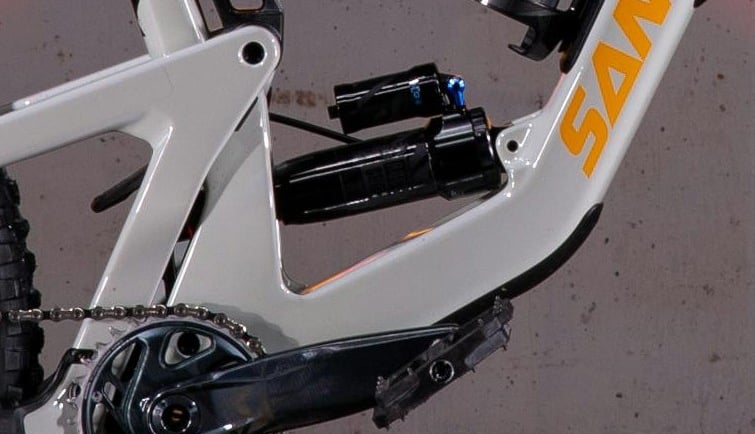
Modern mountain bike design has evolved dramatically over the past two decades. One noticeable trend is the repositioning of the rear shock absorber lower in the frame, often closer to the bottom bracket area. This change is especially common in enduro, downhill, and aggressive trail bikes. But considering the combined weight of the bike and a fully equipped rider, does lowering the shock actually deliver meaningful benefits? Or is it mostly marketing and aesthetics?
This article explores the physics, engineering, and real-world performance implications of a lower shock position.
Understanding the System: Bike and Rider as One Mass
Before examining shock placement, it's important to understand that the mountain bike and rider function as a single dynamic system.
Typical weights:
Mountain bike: 13–18 kg
Rider (average adult): 70–90 kg
Gear (helmet, pack, armor, water, tools): 3–8 kg
Total system mass: 85–115 kg
This means the shock absorber itself, weighing around 300–500 grams, represents less than 0.5% of the total system mass. At first glance, this suggests moving it lower would have minimal effect. However, its position still influences performance through center of gravity, frame dynamics, and suspension behavior.
Key Benefits of a Lower Shock Position
Lower Center of Gravity (CG)
One of the most significant advantages is reducing the bike’s center of gravity.
Even though the shock is relatively light, it is part of the bike’s sprung mass — the portion of the bike supported by the suspension. Lowering components of the sprung mass contributes to lowering the bike's overall CG.
Benefits of a lower CG include:
Improved cornering stability
Reduced tendency to tip sideways
Better balance in technical terrain
More planted feel at speed
This is especially noticeable when cornering aggressively or riding steep downhill sections.
While the rider’s body contributes most to CG height, lowering the bike's CG still improves handling because the bike itself becomes more stable beneath the rider.
Improved Frame Stability and Reduced Pitching
Mountain bikes experience pitching forces during:
Braking
Accelerating
Riding steep descents
Lower shock placement concentrates mass closer to the bottom bracket, which is the rotational center of the bike during pitching motions.
This results in:
Reduced rotational inertia
Faster suspension response
Less unwanted frame movement
The bike feels calmer and more predictable, particularly in rough terrain.
Improved Suspension Performance Through Better Leverage Design
Lower shock positioning often allows engineers greater flexibility in suspension kinematics.
This enables designers to optimize:
Leverage ratios
Anti-squat characteristics
Progression curves
The result is suspension that can be:
More sensitive to small bumps
More supportive under pedaling
More progressive at the end of travel
This improves both comfort and control.
Importantly, this benefit comes not just from the shock being lower, but from the design freedom that lower placement provides.
Increased Frame Stiffness and Strength
Lower shock positioning often allows:
Shorter linkage components
More compact frame triangulation
Stronger structural load paths
This improves torsional stiffness.
Benefits include:
More precise handling
Better tracking in rough terrain
Improved power transfer
A stiffer frame allows the suspension to work properly instead of the frame flexing.
Improved Rider Confidence and Perceived Stability
Even if the measurable physics benefit is small, rider perception matters enormously.
Bikes with lower mass concentration feel:
More stable at speed
Easier to lean into corners
Less "top heavy"
This improves rider confidence, which directly improves performance.
Confidence allows riders to:
Corner faster
Brake later
Ride more aggressively
These performance gains often outweigh pure physics gains.
Are the Benefits Significant Given the Rider's Weight?
This is the most important question.
From a purely physics standpoint:
The rider accounts for roughly 80–90% of the total system mass.
This means:
Moving the rider's body position has far greater impact than moving the shock.
For example:
Standing vs sitting changes CG far more than shock placement ever could.
However, shock placement still matters because:
It affects frame behavior independently of rider mass
It influences suspension kinematics
It affects rotational inertia of the frame itself
These effects are subtle but real.
The Most Important Real Benefit: Mass Centralization, Not Just Lowering
The biggest advantage is not simply lowering the shock — it is centralizing mass near the bottom bracket.
Benefits of centralized mass:
Reduced rotational inertia
Easier bike maneuverability
Faster direction changes
More responsive handling
This is especially noticeable in:
Technical trails
Jump lines
High-speed rough terrain
Mass centralization improves how the bike feels during rapid directional changes.
Real-World Impact: Who Benefits Most?
Significant benefit for:
Downhill riders
Enduro riders
Aggressive trail riders
Riders on steep, technical terrain
Riders riding at high speed
Smaller benefit for:
Casual riders
XC riders on smoother terrain
Low-speed riding
At low speeds, the benefits are much harder to notice.
Engineering Benefits vs Marketing Claims
Some benefits are real and measurable:
Real engineering benefits:
Improved suspension kinematics
Better frame stiffness
Improved mass centralization
Slightly improved stability
Smaller benefits often exaggerated:
Massive CG improvements (rider mass dominates)
Dramatic handling differences solely from shock height
Shock placement alone does not transform performance — it is part of an overall system design.
The Bottom Line: Are There Real Benefits?
Yes — but they are subtle and indirect.
Lower shock positioning provides real advantages through:
Improved frame design flexibility
Better suspension performance
Slightly improved stability
Better mass centralization
However, the rider's body position has far greater influence on overall center of gravity.
The greatest benefits come from improved suspension kinematics and frame stiffness — not simply lowering weight.
Final Verdict
Lower shock placement is a genuine engineering improvement, but not a miracle change.
Its benefits are:
Real
Measurable
Incremental rather than dramatic
When combined with modern geometry, linkage design, and frame stiffness improvements, lower shock positioning contributes meaningfully to the exceptional performance of modern mountain bikes.
On its own, the effect is modest — but as part of an integrated design, it plays an important role in improving control, stability, and suspension performance.