
Revved Carbon
A Cleaner Carbon Story… or Just a Clever One?
NEWBIKE GREEN
4/23/20264 min read
Revved Carbon and the Sustainability Question
A Cleaner Carbon Story… or Just a Clever One?
Carbon fibre in mountain bikes has always had a bit of a split personality.
On one hand, it’s the dream material—light, stiff, fast, and just exotic enough to make you feel cool.
On the other hand, it’s a bit high maintenance in production terms: energy-hungry to make, difficult to recycle, and usually treated as something you ride hard, then quietly worry about later when it eventually meets a rock at the wrong angle.
So when Guerrilla Gravity introduced Revved Carbon, it didn’t feel like just another frame material launch. It felt more like someone walking into the room and asking a slightly uncomfortable question:
What if carbon didn’t have to work like this?
So what actually was Revved Carbon?
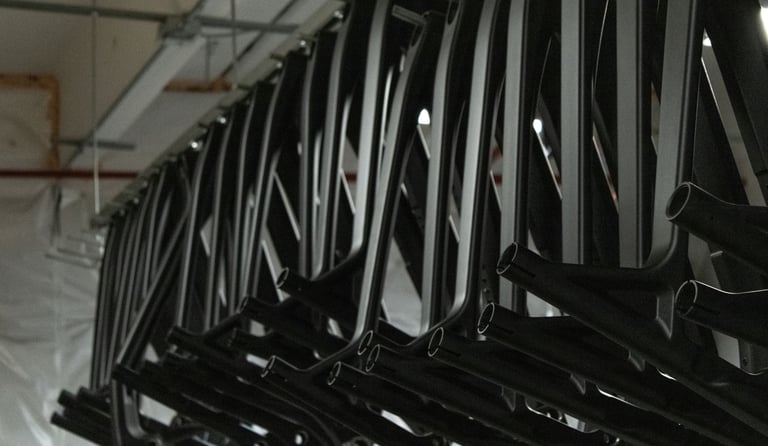
At its core, Revved Carbon was Guerrilla Gravity’s take on a thermoplastic composite system used in their frames.
That sounds very lab-coat, but the idea behind it was pretty straightforward: instead of using traditional thermoset carbon (the kind that gets laid up, cured, and then basically set forever), Revved used a different resin system and manufacturing approach that aimed to simplify production and change what happens at the end of a frame’s life.
In practice, that meant:
Faster manufacturing
Less finishing and sanding work
A different way of bonding fibres and resin
And at least in theory, a better shot at recyclability than conventional carbon
It wasn’t trying to reinvent mountain bikes.
It was trying to rethink the material they’re made from.
The sustainability angle: where it got interesting
Revved Carbon’s environmental story wasn’t built on one big dramatic claim. It was more like a collection of smaller, practical improvements that added up to something meaningful—at least on paper.
Less waste in the factory
Traditional carbon manufacturing can be surprisingly messy. Lots of hand finishing, trimming, sanding, and cosmetic work.
Revved’s process reduced a lot of that. Fewer finishing steps generally means less wasted material and less energy spent just making things look perfect.
It’s not glamorous, but it matters.
Faster production
One of the more talked-about aspects was that Revved frames could be produced much faster than traditional carbon frames.
From a sustainability perspective, that opens a few doors:
Lower energy use per frame
Potential for more localised production
Less reliance on long, complex supply chains
It’s one of those improvements that doesn’t sound exciting until you zoom out and realise how industrial carbon production normally works.
The thermoplastic idea
This is the part that gets most of the attention.
Traditional carbon fibre is usually a thermoset material—it’s essentially “set” permanently once cured. That makes it strong, but also very hard to recycle.
Revved used a thermoplastic-based approach, which in theory can be reheated and reprocessed under certain conditions.
That sounds small, but conceptually it changes the conversation from:
“This frame is basically permanent waste at end-of-life”
to something closer to:
“Maybe this material has a second life”
That “maybe” is doing a lot of work there—but it’s still a shift.
Durability as a form of sustainability
Another part of the argument was simple: Revved frames were designed to be tough.
And in sustainability terms, toughness matters more than people like to admit.
If a frame lasts longer, gets replaced less often, and survives impacts that might otherwise write off a bike, then the environmental impact per year of riding goes down.
It’s not flashy, but it’s one of the more honest sustainability levers in cycling:
Keep it in service longer.
Where things get less neat
Of course, no material story in cycling stays clean for long.
Even with all the improvements, Revved Carbon didn’t magically solve carbon fibre’s biggest problems.
Recycling is still complicated
Thermoplastics improve the theoretical recyclability story, but in reality:
Composite recycling infrastructure is limited
Separating fibres and resin is still difficult
Economic systems for recycling carbon frames are still immature
So while Revved moved things forward, it didn’t suddenly create a closed-loop carbon economy.
It’s still carbon fibre
Even with a different process, you’re still dealing with a material that requires significant energy and industrial input to produce.
So the footprint may be improved in places, but it doesn’t disappear.
Scale still wins
This is the quiet reality behind most sustainability stories.
Even if each frame is more efficient, the total impact depends on how many are made, sold, and replaced.
Efficiency helps.
But consumption patterns decide the outcome.
The bigger idea behind it all
What makes Revved Carbon interesting isn’t just the material itself.
It’s the mindset behind it.
Instead of asking only:
“How do we make carbon lighter?”
or“How do we make it stiffer?”
Guerrilla Gravity was also asking:
“How do we make it simpler to produce?”
“How do we reduce waste in making it?”
“How do we think about its end-of-life?”
That last question is still where the industry is struggling the most.
The slightly awkward ending
Guerrilla Gravity eventually shut down, which means Revved Carbon didn’t get a long runway to fully prove itself at scale.
And that leaves it in an interesting place.
Not a finished revolution.
More like a half-built argument the industry is still responding to.
Because even if Revved wasn’t the final answer, it did something important:
It made carbon fibre feel less like a fixed material, and more like something that could still be rethought.
And in an industry that often fine-tunes rather than reinvents, that alone is worth remembering.