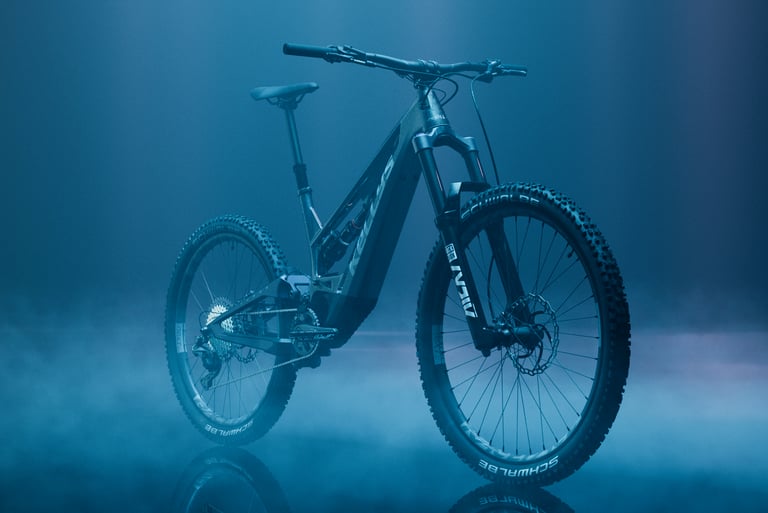
KELLYS THEOS F100
Is this Frame Material the Answer The Carbon Question
ARTICLES
1/7/20265 min read
The Future of Trail Riding Has a Name
KELLYS THEOS F100
Some bikes are built to compete. Others are built to impress. And then, once in a while, something comes along that quietly shifts the benchmark for what’s possible.
The KELLYS THEOS F100 Carbon-Aramid Composite is one of those machines.
Designed by Slovakian Bike Manufacture Kellys and manufactured in Europe, this full-powered e-MTB doesn’t just blend cutting-edge engineering with progressive trail geometry — it wraps it all in a frame that feels purposeful, refined, and undeniably cool. From the first glance to the last descent of the day, the THEOS F100 carries a sense of intent. Every line, every contour, every integration choice tells the same story: this bike was thought through, not rushed.
Carbon-Aramid: Strength with a Conscience
At the core of the THEOS F100 lies its Carbon-Aramid Composite frame — a material choice that’s about more than shaving grams. By blending high-modulus carbon with aramid fibers, KELLYS achieves a structure that is exceptionally strong, impact-resistant, and remarkably light.
The frame was developed in conjunction with REIN4CED a Belgian-based company specializing in lightweight, durable thermoplastic composite materials for high-performance applications, including automotive and aerospace. They developed a unique, automated production technology designed for high-volume manufacturing of carbon fiber components, aimed at improving strength and durability for specialized automotive and racing applications.
In real-world terms? A full-powered e-MTB that hovers around 20.6 kg. That’s astonishing territory for a bike carrying an 825 Wh battery and a high-torque motor.
But the material story goes deeper than performance. Durability is sustainability’s quiet ally. A stronger, more resilient frame means fewer premature failures, longer product life, and less material waste over time. By engineering for longevity rather than disposability, KELLYS is embracing one of the most powerful sustainability principles there is: build it to last.
Manufacturing within Europe further supports this philosophy. Shorter supply chains reduce transport emissions. Production oversight aligns with strict EU environmental standards. Quality control is tighter. The environmental footprint is more transparent. Sustainability isn’t a sticker on the downtube — it’s embedded in the process.
The Closed-Loop Vision
The cycling industry, like many high-performance sectors, faces challenges when it comes to composite recycling. But the THEOS F100 is built with the future in mind.
The modular, integrated removable battery system makes end-of-life disassembly more practical. The battery can be removed, serviced, replaced, or recycled independently of the frame. That’s crucial for circular economy potential — separating energy storage from structural materials allows each to follow its appropriate recycling stream.
European battery regulations already require responsible collection and recycling of lithium-ion systems. The 825 Wh Re-Charge K1 battery is designed to be removable not just for convenience, but for lifecycle responsibility. When the battery reaches the end of its useful life, it doesn’t condemn the bike to obsolescence. It becomes a serviceable component within a broader loop.
Closed-loop composite recycling technology continues to advance across Europe, especially in automotive and aerospace sectors. By utilizing automotive-grade composite expertise, KELLYS positions the THEOS platform within an ecosystem that is steadily moving toward reclaiming and repurposing carbon fibers at scale.
Sustainability here isn’t about claiming perfection — it’s about designing in a direction. Serviceability. Replaceability. Longevity. Reduced transport impact. Responsible battery management. These decisions matter.
Think Link® Suspension: Controlled Chaos
Trail performance remains the heart of the THEOS F100. The Think Link® suspension system delivers 140 mm of rear travel tuned for efficiency and composure. It pedals crisply under load yet opens up when the terrain turns aggressive. Paired with a 150 mm fork and a mullet wheel configuration — 29” up front for rollover confidence, 27.5”+ at the rear for agility and traction — the bike feels planted but playful.
The 12x148 mm Boost thru axle anchors stiffness. The 1.8” tapered head tube increases front-end precision. A post mount 203 mm setup ensures braking power matches descending ambition.
This isn’t just suspension travel on paper — it’s balance. Stability at speed. Flickability in tight sections. A ride character that feels alive, not muted.
Power Without Penalty
Underneath the sleek carbon shell sits the Shimano EP801 motor, delivering 85 Nm of torque in a way that feels intuitive rather than overwhelming. It doesn’t surge; it amplifies. Climbs that once drained energy become controlled, repeatable efforts. Technical ascents feel achievable instead of punishing.
And then there’s the battery.
The 825 Wh Re-Charge K1 pack delivers serious range, but what’s remarkable is its energy density. Weighing approximately 3.9 kg, it achieves over 200 Wh per kilogram — a figure that pushes efficiency boundaries. That means extended ride time without tipping the scale into cumbersome territory.
The integrated Retractable Battery System keeps the frame silhouette clean while allowing practical removal for charging or transport. Slide it out. Charge indoors. Reinstall securely. No compromise in frame integrity. No awkward external bulk.
For riders who measure days in elevation meters and hours in the saddle, this combination of range, power, and weight changes the equation. Full power no longer means full heft.
Let’s Talk About How It Looks
There’s something undeniably striking about the THEOS F100.
It doesn’t scream. It smolders.
The lines are muscular without being bulky. The integration of the battery is seamless — no swollen downtube, no ungainly protrusions. The mullet stance gives it a forward-leaning, ready-to-pounce posture. The carbon-aramid weave beneath the finish hints at the engineering beneath the surface.
It looks fast standing still.
The proportions are balanced. The 1.8” head tube adds a subtle sense of authority up front. The clean motor integration keeps the bottom bracket area tight and purposeful. It’s a bike that draws attention not because it’s loud, but because it looks resolved.
And when you know it ranks among the lightest full-powered e-MTBs in its category, the aesthetic takes on even more meaning. This isn’t visual aggression masking excess weight. It’s lean strength — performance expressed visually.
The Lightest and Strongest in Its Class
Full-powered e-MTBs typically demand compromise. Add a big battery, and weight climbs. Boost stiffness, and compliance can suffer. Increase power, and integration becomes bulky.
The THEOS F100 refuses to accept those trade-offs.
By combining carbon-aramid composite construction, high-density battery technology, and a refined motor system, KELLYS has created one of the lightest full-power platforms available — without stepping down to a reduced-power motor or smaller battery.
It’s strong enough for aggressive terrain. Light enough to remain playful. Powerful enough to redefine long rides. And engineered with an eye toward sustainability that acknowledges the responsibilities of modern manufacturing.
More Than a Machine
The KELLYS THEOS F100 isn’t just an electric mountain bike. It’s a statement about where high-performance cycling is heading.
Performance without wasteful excess. Power without bulk. European manufacturing with environmental oversight. A removable battery system that supports circular thinking. A composite frame built for durability and future recycling potential.
And yes — it’s outrageously cool.
In a category crowded with numbers and noise, the THEOS F100 stands out because it feels intentional. It rides like the future. And it’s built with the understanding that the future matters.