
Head Angle Talk
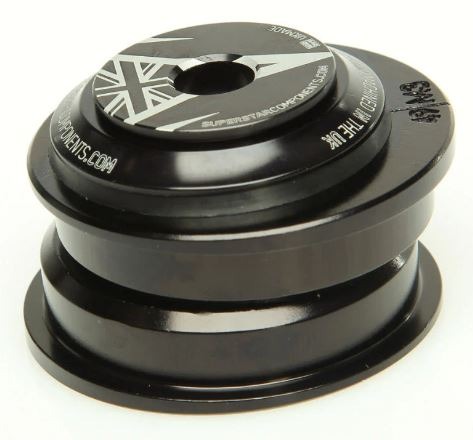
Slackening the front of your mountain bike.
What does this mean?
(Changing the head angle of you bike to make your forks point more forward and at the same time moving the front wheel further away from the rider )
How Far Can a Head Angle adjusting Headset Take You Toward Modern Geometry?
There’s a long-standing idea in mountain biking that chasing a more modern ride doesn’t always require a brand-new frame. Geometry has become the industry’s obsession in recent years longer, slacker, lower but sometimes, achieving that feel is less about replacing your bike and more about rethinking a single component.
Enter the angle-adjust headset: an unassuming, slightly eccentric piece of kit that has been quietly reshaping bikes for years.
Despite its low profile, it’s far from niche. More riders have experimented with angle headsets than you might expect, often in pursuit of that elusive “just right” handling feel. My own introduction came when I fitted one to an Ibis Mojo HD 160. The transformation wasn’t dramatic in appearance, but on the trail, it was immediately noticeable—subtle, yes, but undeniably effective.
So what exactly does it do?
In a standard setup, your fork’s steerer tube passes straight through the head tube, aligned exactly as the frame designer intended. An angle-adjust headset alters that path. By offsetting the bearing cups, it allows the steerer to sit at a slight angle either forward or backward relative to the frame.
The result is a change in your bike’s head angle: slackening it for greater stability at speed, or steepening it for sharper, more responsive handling. Typically, these adjustments range from around one to two degrees, but even that small shift can significantly influence how a bike feels beneath you.
Many modern frames now incorporate adjustable geometry as part of their design, reflecting how central these tweaks have become. But for bikes that don’t offer that flexibility—particularly older models built before the current geometry trends took hold—an angle-adjust headset provides a clever workaround.
It’s not a magic fix, nor a substitute for a frame designed around contemporary geometry from the ground up. But it is a reminder of something mountain bikers have always understood: sometimes, the biggest improvements come not from wholesale upgrades, but from thoughtful, well-chosen adjustments.
A degree or two, it turns out, can go a long way.
But how far does it really go?
Let’s take a bike that already sits a little closer to modern numbers and see what happens.
The starting point
We begin with:
Bottom bracket height: 35 cm
Head angle: 67°
Seat tube angle: 72°
Wheelbase : 1150 cm
This is a slightly more progressive setup than some older trail bike but still has a relatively steep head angle by modern standards
Step one: fitting a 2° angle headset
We install an angle headset to slacken the front end.
New geometry (approximate):
Head angle: 67° → 65°
Seat tube angle: 72° → ~74°
BB height: 35 cm → ~33.5 cm
Wheelbase 1150 → 1170
What’s happening:
The front of the bike drops slightly
The frame rotates forward
The whole bike becomes lower and more aggressive
The longer wheel base gives better stability at high speed
Step two: adding spacers to maintain bar height
We then add spacers under the stem to bring the handlebar height back to its original position.
Important:
This restores fit, not geometry
The bike remains slacker and lower
Body position feels familiar, but the chassis has changed
Final setup
Measurement Before and After
Head angle 67° before 65° After
Seat tube angle 72° before 74° After
BB height 35 cm before 33.5 cm After
Wheelbase 1150 cm before 1170 cm After
How does this compare to a modern trail bike?
A typical modern trail bike (2025–2026) tends to look like:
Measurement Modern Range
Head angle 64–65°
Seat tube angle 75–77°
BB height~33–34.5 cm
Wheelbase 1200 cm
Where our modified bike now sits
Head angle → Fully modern
At 65°, is right in line with current bikes.
Bottom bracket → Very close
At 33.5 cm, is in the modern window
Lower, more stable, more planted.
Seat tube angle → Almost there
At 74°, things have improved things significantly, but still not inline with modern bikes.
Slightly slacker than modern bikes
A bit further back over the rear wheel when climbing
Wheelbase → Not a Fully modern.
The extra length may be small but the increase will give noticeable stability improvements at speed.
What you still can’t replicate
Even though the numbers look close, there are deeper geometry differences we can’t reach with a headset:
Reach (frame length) → modern bikes are longer
Wheelbase longer → more stability at speed
Front centre → better weight distribution
Seat tube position relative to BB → more efficient climbing
These define how a modern bike really rides.
How it feels on the trail
Compared to the original bike:
More confidence on descents
Better cornering grip
Lower, more planted feel
Slightly improved climbing position
Less responsive in tight switchbacks
Compared to a modern bike:
Still a bit shorter and more compact
Still not as forward when climbing
Slightly less stable at very high speeds
Slightly better at climbing in tight turns
The interesting middle ground
This setup creates a kind of “in-between” bike:
Modern head angle
Near-modern BB height
Semi-modern seat angle
Classic frame proportions
It doesn’t fully transform the bike but it meaningfully evolves it.
Not everyone is looking for the extreme geometry of a modern trail bike so this could be perfect for many riders.
The bigger takeaway
An angle headset isn’t just a quick fix it’s a way to shift your bike along the timeline of geometry evolution.
It's not turning the bike into a 2026 machine. But will push it firmly in that direction.
And when paired with a simple cockpit adjustment to keep your fit consistent, it becomes one of the most effective and underrated ways to modernize how a bike rides without replacing it.
Final thought
In a sport that constantly pushes for new bikes and new standards, there’s something quietly satisfying about making an old bike better.
Just by understanding how a few degrees can change everything.