Bamboo Voodoo
Why Bamboo Keeps Getting Invited Back to the Bike Industry Party
BIKE GREEN
4/20/20263 min read
From a sustainability perspective, bamboo is basically an overachiever.
It grows fast — absurdly fast — with some species shooting up to full height in a single growing season. It regenerates without replanting, needs little in the way of pesticides, and happily absorbs carbon while it’s at it. Compared to digging aluminium out of the ground or baking carbon fibre in energy-hungry autoclaves, bamboo’s environmental résumé looks… annoyingly good.
Then there’s the material itself. Bamboo has a high strength-to-weight ratio, excellent vibration damping, and a naturally fibrous structure that makes it surprisingly tough. Riders who’ve spent time on bamboo frames often describe them as smooth, calm, and forgiving — less jackhammer, more jazz drummer.
On paper, it sounds like a dream. On trails and roads, it mostly delivers. But paper and reality aren’t always on speaking terms.
The Very Real Upsides of Bamboo Frames.
Let’s give credit where it’s due — bamboo does a lot of things right.
It’s genuinely comfortable
Bamboo naturally absorbs vibration. That translates to less trail buzz, less road chatter, and a ride quality that many people compare to high-end steel — but with a personality of its own.
It’s strong where it needs to be
Certain bamboo species have tensile strength that can rival steel in specific applications. No, you’re not racing the Tour de France on raw bamboo tubes, but for real-world riding, it’s more than capable when designed properly.
It looks? - I suppose this a personal thing.
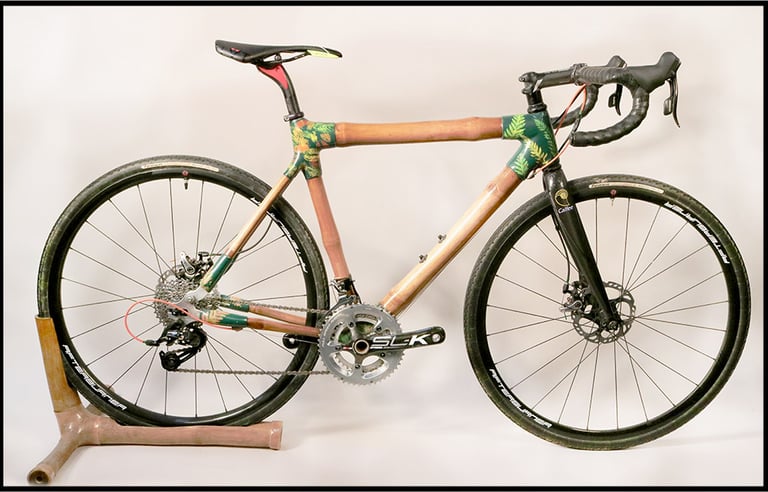
This shouldn’t matter, but it absolutely does. Bamboo bikes are beautiful to some and not so much to others. They look handmade, warm, and human in a world of increasingly anonymous carbon moulds.
It can be very low impact
When sourced responsibly and treated well, bamboo frames can have a significantly lower carbon footprint than conventional frames — especially when made locally or in small production runs.
So Why Aren’t Bike Shops Full of Bamboo Frames?
Here’s where the fantasy meets the workshop.
Bamboo is not a standardized material
Aluminium comes in known alloys. Carbon fibre comes in known layups. Bamboo comes in… bamboo. Each tube is different. Wall thickness varies. Moisture content varies. Strength varies.
That makes large-scale, repeatable manufacturing a nightmare.
It’s labour-intensive.
A bamboo frame isn’t stamped out by a robot. It’s selected, cut, treated, mitred, bonded, wrapped, cured, and finished, largely by hand. That’s great for craftsmanship and terrible for economies of scale.
A single frame can take dozens of hours to produce. That alone puts bamboo at a disadvantage in a price-sensitive industry.
Durability depends heavily on treatment
Bamboo hates moisture, UV exposure, and neglect. If it’s not properly sealed and maintained, it can degrade. Modern bamboo frames solve this with resins and coatings — but that introduces another awkward sustainability question: how green is a plant wrapped in epoxy?
Consumer scepticism is real.
Let’s be honest: a lot of riders still hear “bamboo bike” and think “novelty.” Convincing someone to trust a frame made of grass at 40 km/h takes education, transparency, and a strong brand story.
Yes, People Are Actually Selling Bamboo Bikes
Despite the challenges, bamboo bikes are not a theory experiment. They exist — commercially.
Calfee Design, one of the most respected names in custom cycling, has been building bamboo frames for years. Their bikes have been raced, tested, and proven, often using bamboo tubes paired with composite joints for strength and consistency.
In Europe, brands like Etika Bikes have leaned hard into sustainability, sourcing bamboo responsibly and backing their frames with proper testing rather than vibes.
Elsewhere, smaller builders and workshops produce bamboo frames in limited runs — not mass production, but very real commercial products sold to very real riders.
What you don’t see is a major brand rolling bamboo frames off an automated production line by the tens of thousands. And that tells you everything you need to know about where bamboo fits today.
So… Is Bamboo a Real Solution or a Beautiful Dead End?
The honest answer: both.
Bamboo is absolutely viable for niche, low-volume, sustainability-focused bikes. It works. It rides well. It has a compelling environmental story. For riders who value comfort, craftsmanship, and reduced impact, bamboo makes a lot of sense.
But as a replacement for aluminium or carbon in mainstream commercial production? Not yet — and maybe not ever.
The very qualities that make bamboo appealing — natural variation, hands-on construction, organic materials — are the same ones that make it hard to industrialize. And unless the bike industry fundamentally changes how it values speed, scale, and profit, bamboo will likely remain a specialist option rather than a standard one.
Still, in a world increasingly aware of its environmental footprint, bamboo bikes quietly ask an uncomfortable question:
What if “better” doesn’t always mean lighter, stiffer, and faster — but calmer, longer-lasting, and kinder?
And honestly? That’s a question worth riding with.